Unregulated opioid-like drug hits Lawrence smoke shops, experts warn of risks
Nov. 24, 2025
An unregulated and potentially dangerous drug can be purchased at Lawrence smoke shops.
The substance, known as 7-hydroxymitragynine or 7-OH, is marketed in tablets, vapes and drinks that resemble kratom products. But people who have used it say the effects can be extreme.
One recovering user told The Kansas City Star she was spending hundreds of dollars a week on 7-OH and saw her hair fall out, her appetite disappear, and her energy collapse before she quit in March.
High doses of 7-OH can mimic prescription opioids and lead to respiratory depression, said Oliver Grundmann, a clinical toxicologist and professor at the University of Florida. Naloxone can reverse those effects, but users often don’t realize they’re taking something that behaves like an opioid.
The Drug Enforcement Administration is reviewing the Food and Drug Administration’s recommendation to control certain 7-OH products. The products are illegal in Florida as of August, but are almost entirely unregulated elsewhere in the United States, including Kansas and Missouri. This means anyone older than 21 can legally buy it without a prescription.
Christopher McCurdy, a leading 7-OH researcher and medicinal chemistry professor at the University of Florida, said unregulated drugs like 7-OH are dangerous in part because they are made in facilities that do not disclose or inspect what is inside, such as substances left behind by synthetic processing.
Although tiny, naturally-occurring traces of 7-OH exist in dried kratom leaves, the versions sold in smoke shops are synthetically created to be much stronger, according to a Kansas Department of Health and Environment warning issued Sept. 24.
The products often look similar to kratom leaf products and are sometimes sold side-by-side, despite being chemically different and significantly more potent.
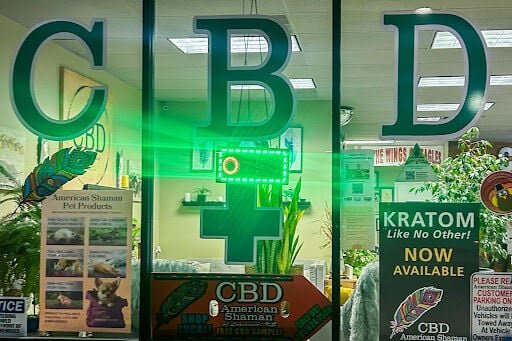
One of Lawrence’s two CBD American Shaman stores advertises kratom products in the window on Nov. 5. The Kansas City Star reported that a 29-year-old recovering user said she first tried 7-OH after receiving a free sample with a CBD purchase at a similar retailer.
Even scientists have a limited understanding of how 7-OH works. Grundmann, who has studied kratom extensively, said much about the drug’s effects remains unknown. McCurdy added that because natural 7-OH appears only in extremely small quantities, researchers must synthesize it for study, which can be an expensive and difficult process.
Local public health officials were unaware of 7-OH until KDHE issued its alert. Vicki Collie-Akers, a director at Lawrence-Douglas County Public Health and an associate professor at the University of Kansas Medical Center, said the department licenses tobacco retailers in Lawrence but had not encountered 7-OH in previous inspections.
She said there are about 83 of these stores open in Lawrence currently, a higher density than in Johnson County, and many sell 7-OH products.
After learning about the substance, her environmental health team began checking local stores. Of the six shops visited so far, one grocery store and two convenience stores did not carry 7-OH, while three smoke shops did.
KU students who find themselves in a substance-use crisis can seek support through the Health Education and Resource Office or Counseling and Psychological Services. Naloxone is also available for free at several locations around Lawrence.